 Itemlume
DIAGNOSTIC GUIDE / A+ product pages
How do I distinguish a brand's home country from where the product is made?
A brand’s home country does not establish where every product is made. Record brand registration, design location, manufacturing origin, and dispatch location as separate facts supported by merchant documents. Use wording that states only the confirmed relationship. Do not let a flag, brand story, or English-sounding name imply a product origin that the seller has not verified.
Create four distinct location fields
Start with the actual SKU and list the relevant entities and locations separately. Brand ownership or registration concerns an organization; manufacturing concerns the offered product; design and dispatch describe other parts of its history and fulfillment. One verified field cannot automatically populate the others.
Ask the merchant for the source behind each statement and its current relevance. A company address on an invoice might be a trading office rather than a factory. A warehouse address does not establish production origin. Record the document’s purpose, not just the country name that appears on it.
Review both wording and country symbols
A short phrase such as British brand can be read differently from made in Britain. Keep the distinction explicit when both facts matter. Do not transform a confirmed brand story into a manufacturing statement during translation, summarization, or AI rewriting. Match the offered SKU’s source rather than a general company biography.
Check flags, landmarks, maps, and badges in the artwork. They can imply a broader origin claim than the adjacent sentence. If the visual and text suggest different meanings, revise them together. This guide provides an evidence-separation process, not a legal determination of country-of-origin labelling.
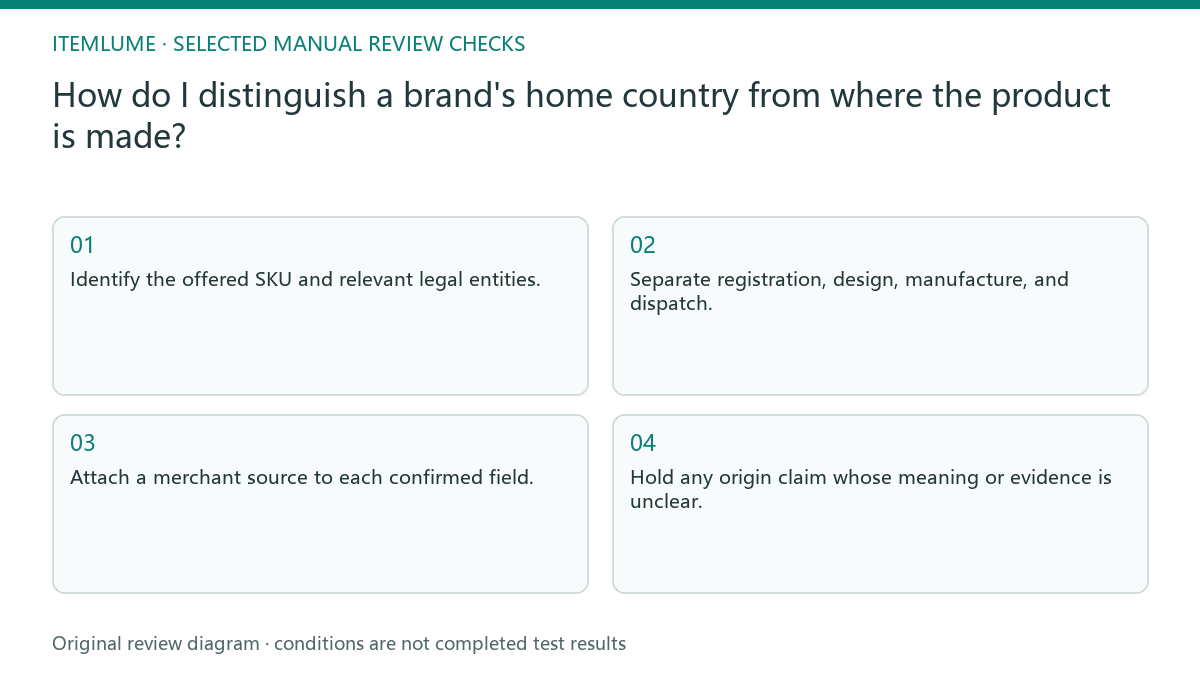
- Identify the offered SKU and relevant legal entities.
- Separate registration, design, manufacture, and dispatch.
- Attach a merchant source to each confirmed field.
- Compare translated wording and country imagery.
- Hold any origin claim whose meaning or evidence is unclear.
A fictional homeware brand
Fictional exercise: a homeware brand is registered in the UK, its product is manufactured elsewhere, and orders ship from a regional warehouse. A draft uses a large UK flag and says British-made. The review finds that only brand registration supports the UK connection. The scenario is hypothetical, with no investigated company.
The revised brief distinguishes the brand’s background from the product’s documented manufacture and fulfillment. If the supplier origin is not verified, omit that assertion rather than guess it. Stop when a campaign symbol still implies the rejected manufacturing claim; removing only the words may leave the same misleading meaning.
Keep scope stable across versions
Retain the source fields and approved wording with each product variant. A brand can sell goods from several factories or countries, so copying a location claim across the catalogue needs review. Source changes and supplier changes can invalidate an old statement even when the brand identity remains the same.
Itemlume can rewrite confirmed facts but cannot inspect factories or determine origin from photos. General product-fidelity guides support the need for evidence, not these hypothetical location facts. Ask the merchant to obtain authoritative records and appropriate specialist review when formal origin labelling is involved. Do not approve a claim simply because AI repeats it confidently.
Location fact and source map
| Field | Source question | Do not substitute |
|---|---|---|
| Brand registration | Which organization and record? | Manufacturing origin |
| Design location | Who designed this version where? | Factory location |
| Manufacture | What supports this SKU’s origin? | Warehouse address |
| Dispatch | Which fulfillment location applies? | Country of production |
Use this matrix as a manual review record and add your own real evidence. Its conditions are not completed test results.
Sources and further reading
Sources for this page were checked on . Platform rules can change; verify the current source before publishing. Prompt examples and workflow recommendations are Itemlume editorial guidance, not independently measured results.
Frequently asked questions
Does the brand country equal made-in country?
No. Establish those facts independently for the offered product.
Can an address on packaging settle everything?
No. It may describe an importer or office. Confirm what the address actually represents.
Can AI identify origin from style?
No. Appearance, language, and branding do not establish manufacturing origin.
BUILD FROM A PRODUCT YOU KNOW
Put this workflow into practice with your own product.
Explore the relevant tool first. AI copy and concept planning are free after sign-in. Image and video generation require available credits and the applicable account access.
Open A+ product pages Check pricing and credits