 Itemlume
DIAGNOSTIC GUIDE / Image remix
Does a custom-product production time begin at payment or at proof approval?
State the production clock’s real starting event. For a custom item, payment, completed buyer information and approved proof can occur on different dates. A duration without that starting condition may promise an earlier completion than the seller’s workflow supports. Choose one documented start event and distinguish it from completion, dispatch and eventual arrival.
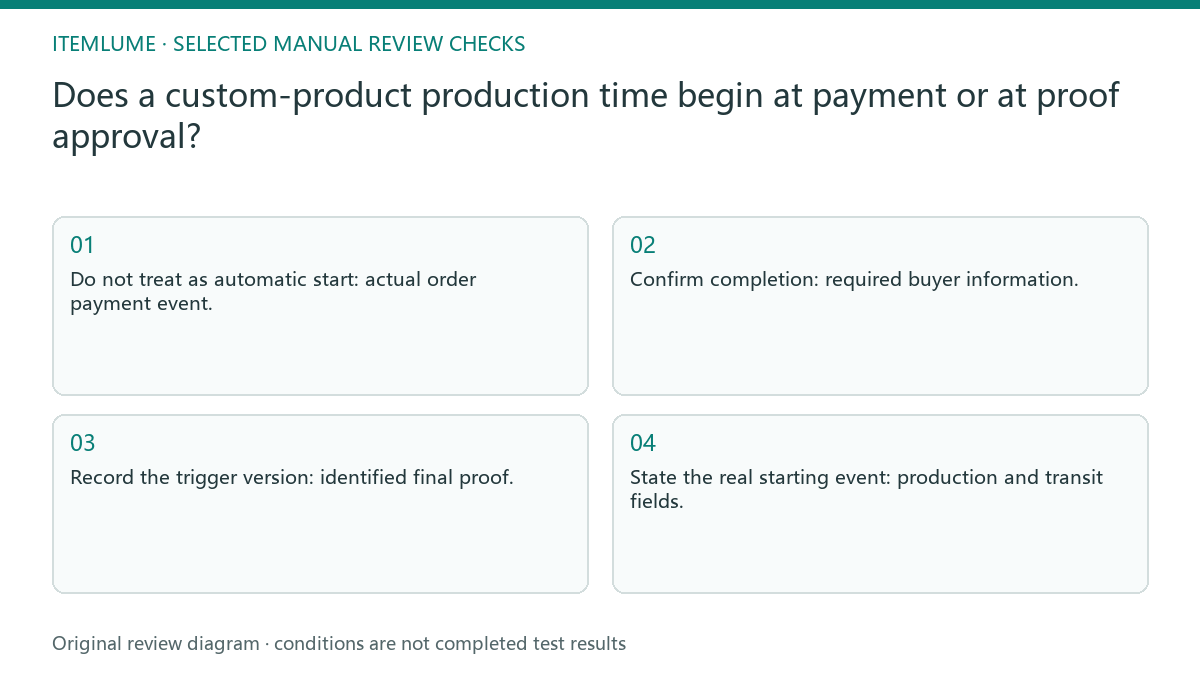
Payment and production start can occur on different dates
A payment timestamp proves payment, not that design inputs are complete. Similarly, a first draft is not necessarily the buyer’s approved production proof. Separate customer waiting time, revision work, production and shipping instead of blending them into a single attractive number.
Map payment, completed information, proof approval, production and dispatch as separate milestones. The seller decides which actually starts the quoted production interval. If buyer information is incomplete, a paid order may still be waiting for a prerequisite rather than already in production.
Name the event that starts the production clock
Map payment, information completion, proof approval, production start and expected dispatch as separate nodes. Ask the seller which node triggers the documented duration and how revisions affect that clock. Put the condition beside the time promise, and keep shipping estimates in their own field.
Use a milestone table with the responsible party and actual condition for each event. State whether the quoted interval ends at completion or dispatch. Avoid inventing a universal calendar rule; clarify working-day or other stated definitions only from the seller’s approved terms.
- Do not treat as automatic start: actual order payment event.
- Confirm completion: required buyer information.
- Record the trigger version: identified final proof.
- State the real starting event: production and transit fields.
A custom nameplate waits for artwork approval
Fictional exercise: a personalized plaque has a stated production period that begins after proof approval. Payment happens earlier, and the customer later corrects the name. The page explains the approval dependency and keeps transit separate. This exercise does not supply a real deadline or determine contractual rights.
For the fictional nameplate, proof approval is the confirmed start event. A revised spelling sends the artwork back for review, so the earlier approval no longer proves the changed version ready. The creative explains that dependency without blaming the customer or inventing a new dispatch date. If the buyer revises the artwork, record which milestone returns to review and who confirms the next start event. Keep the previous proof identifiable. Do not silently retain its date while changing the approved spelling, layout or product configuration.
Do not promise dispatch from an unresolved start
Stop if nobody can identify the timing trigger or revision rule. Keep the draft time promise unapproved until the actual seller clarifies it.
Stop date claims until the milestone definition and current proof status are confirmed. Keep the customer-facing explanation consistent with the actual order route. The seller’s fulfillment owner approves the calendar. AI copy assistance cannot start a production clock, know factory availability or guarantee a delivery date.
Payment to time promise: decision worksheet
| Check | Evidence to record | Review action |
|---|---|---|
| Payment | Actual order payment event | Do not treat as automatic start |
| Inputs | Required buyer information | Confirm completion |
| Approval | Identified final proof | Record the trigger version |
| Time promise | Production and transit fields | State the real starting event |
Use this matrix as a manual review record and add your own real evidence. Its conditions are not completed test results.
Sources and further reading
Sources for this page were checked on . Platform rules can change; verify the current source before publishing. Prompt examples and workflow recommendations are Itemlume editorial guidance, not independently measured results.
Frequently asked questions
Does payment always start the production period?
No. Confirm whether payment, complete information or proof approval is the actual trigger.
Can a changed proof reuse the old approval date?
Not automatically. Confirm approval of the current version and its effect on the start event.
Does production time equal arrival time?
No. Separate production, dispatch and delivery estimates using actual terms.
BUILD FROM A PRODUCT YOU KNOW
Put this workflow into practice with your own product.
Explore the relevant tool first. AI copy and concept planning are free after sign-in. Image and video generation require available credits and the applicable account access.
Open Image remix Check pricing and credits