 Itemlume
DIAGNOSTIC GUIDE / Image remix
How do I separate a one-time customization setup fee from the per-item price?
Separate a one-time setup charge from the charge for each item, then show what the quoted total actually purchases. Use the supplier’s current approved quotation and applicable order conditions. A single low unit-price headline can imply the setup is included when it is not. AI can help explain confirmed figures, but it cannot create a price policy or authorize a customer offer.
Classify charges before writing a headline
Record setup, per-item production, sample and any other confirmed charge as separate rows. State whether a charge is one-time per design, per order or governed by another actual condition. Do not assume a previous setup remains reusable when artwork or supplier changes.
Ask the offer owner which charges are included in the advertised amount and which require a quote. Keep unknowns visible. The source record should name the quotation revision and approval, so a designer does not turn an informal cost estimate into a fixed customer price.
Use an explicit quantity example
If a calculation helps, label its quantity and all example values. Explain that a fixed setup charge and a per-item charge have different behavior as quantity changes. Do not present an average including setup as the same thing as the ongoing unit charge.
Keep the setup condition close to the price statement. A qualification hidden elsewhere may not correct the impression of a prominent unit-price badge. Check the image, description and quotation together, and remove unsupported savings or “free setup” claims rather than allowing AI to infer them.
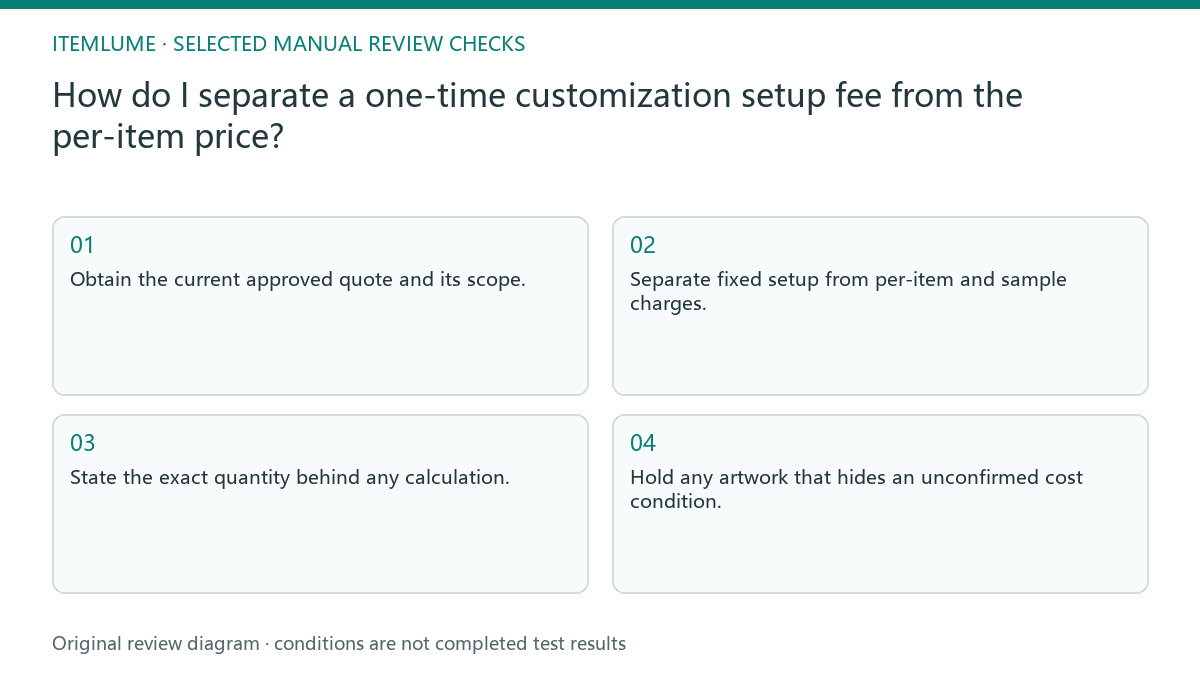
- Obtain the current approved quote and its scope.
- Separate fixed setup from per-item and sample charges.
- State the exact quantity behind any calculation.
- Compare the headline amount with the included-charge list.
- Hold any artwork that hides an unconfirmed cost condition.
Fictional exercise: a setup charge is omitted
This fictional exercise uses a setup charge of 100 units of currency and a charge of 10 per item for 20 items. The illustrated subtotal for those two rows is 300, before any other unconfirmed charges. These figures are invented, not a supplier quotation or financial recommendation.
A headline showing only “10 each” is revised to explain the separate setup and quantity scope. The team checks the calculation against the fictional rows and stops before adding invented tax or shipping. A real offer must replace every example value with approved commercial records.
Approve the offer at the publication moment
Save the quote, included charges and approved artwork together. Recheck when quantity, design or supplier changes. A static price picture cannot update its calculation automatically, and a change to setup reuse can alter the meaning even if the unit amount stays the same. If the artwork displays a subtotal, explicitly name the included charge rows. Do not let a subtotal become an all-inclusive total when the same file is reused in a sales message.
Stop when each visible amount has an approved scope and matches the actual quotation, or hold the price-led asset. Publishing and quotation issuance are external merchant actions. Itemlume drafting does not set fees, calculate a binding offer or synchronize a supplier’s pricing system.
Setup and unit-charge map
| Observation | Manual check | Stop or approve |
|---|---|---|
| Setup row | Confirm one-time condition | Scope approved |
| Unit row | Confirm quantity basis | Do not hide fixed fee |
| Sample row | Check inclusion separately | No assumed credit |
| Total headline | Match included rows | Hold unknown costs |
Use this matrix as a manual review record and add your own real evidence. Its conditions are not completed test results.
Sources and further reading
Sources for this page were checked on . Platform rules can change; verify the current source before publishing. Prompt examples and workflow recommendations are Itemlume editorial guidance, not independently measured results.
Frequently asked questions
Can I divide setup into the unit price?
You can explain an approved quantity-specific calculation, but identify that basis and separate the actual charging policy.
Does one-time mean forever reusable?
No. Verify the actual design, order and supplier conditions.
Can AI fill missing charges?
No. Keep them unconfirmed until the offer owner provides the facts.
BUILD FROM A PRODUCT YOU KNOW
Put this workflow into practice with your own product.
Explore the relevant tool first. AI copy and concept planning are free after sign-in. Image and video generation require available credits and the applicable account access.
Open Image remix Check pricing and credits