 Itemlume
PRACTICAL ANSWER / Product images
Should every handmade ceramic item use the same perfect product photo?
No. Use a representative product photo for a repeatable design only when the listing explains natural variation. If each cup has a distinct glaze pattern, photograph the exact sale unit or show several real examples so buyers can judge what may change.
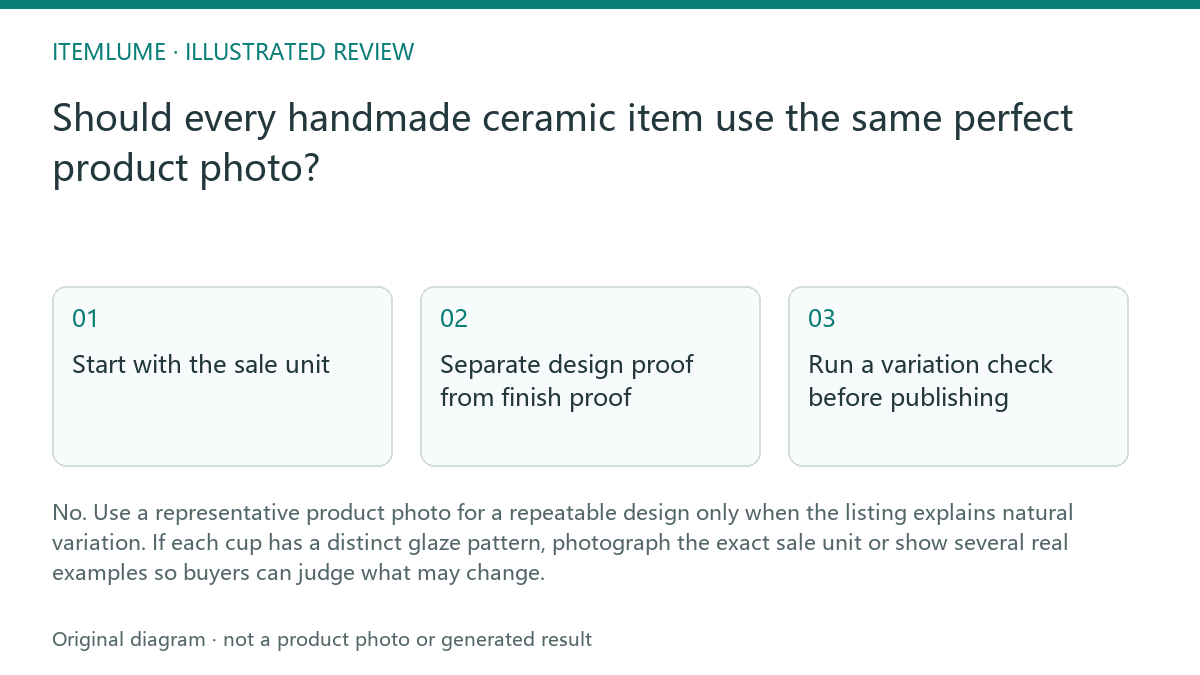
Start with the sale unit
First decide what the buyer is actually purchasing. A standard handmade cup may share a shape, capacity, handle, and glaze family while still having different runs, speckles, pooling, or color transitions. Those differences are part of the product condition, not a camera defect to remove.
Record the sale unit in your listing workflow: one exact cup, one selected cup from a batch, or one item chosen after purchase. Then match the image method to that promise. An exact-unit photo supports a specific-item sale; a representative image supports a made-to-order or batch-based listing only when variation is stated clearly.
Separate design proof from finish proof
A polished hero image can prove the design: silhouette, handle shape, opening, foot ring, and approximate scale. It does not automatically prove the finish on every piece. A generated or heavily edited image may smooth glaze runs, replace speckles, or make three related cups look more identical than they are.
Keep two kinds of evidence visible when variation matters. Use one clean design view for fast recognition, then add real photographs of the actual cup or a small group from the same firing. A caption can distinguish “representative sample” from “exact item shown,” but the image sequence should make that distinction easy to notice.
Run a variation check before publishing
Use a short review sequence before approving the listing.
Approve only the exact-unit or representative-set presentation that the sales record supports.
- 1. Compare the image with the physical cup under neutral, repeatable light.
- 2. Mark every visible glaze feature that may vary, such as runs, spots, pooling, or rim tone.
- 3. Check whether the sale unit is exact, selected from a batch, or made after ordering.
- 4. Rewrite the caption and variation note so the image and promise agree.
- 5. Approve only when a buyer could understand what is fixed and what may change.
Show enough evidence without making the gallery confusing
Three cups with the same design can be more informative than one artificially perfect cup. Photograph them together only if the grouping clarifies variation rather than implying that all three are included. Label the image as an example set, and state whether the buyer receives one cup or the pictured group.
Use the first image for recognition, the next image for real finish variation, and a detail crop for glaze behavior. Do not use a generated scene to invent a cleaner surface, a different color balance, or a finish that has not been observed on the physical stock.
Handmade glaze variation review
| Observation | Next check | Pass condition |
|---|---|---|
| Three cups share the same form but have different glaze runs | Confirm the listing sells one cup and describe the run variation | The image and copy do not imply identical surfaces |
| The hero image looks smoother than the physical cup | Compare edge, speckle, pooling, and rim details under neutral light | No removed or invented finish detail changes the buying decision |
| A batch photo shows multiple cups | Check whether the group is evidence or the actual quantity sold | Caption states representative sample or exact group clearly |
| Color changes between phone and studio images | Compare the physical glaze beside the approved reference photo | The chosen image remains a fair color guide with a variation note |
Sources and further reading
Sources for this page were checked on . Platform rules can change; verify the current source before publishing. Prompt examples and workflow recommendations are Itemlume editorial guidance, not independently measured results.
Frequently asked questions
Should I show every cup separately?
Only when each unit is materially different or the buyer selects the exact piece. Otherwise, use a representative sample plus real variation examples.
Can a generated image show my glaze more clearly?
It may support a scene or composition, but it should not invent a finish or replace evidence of the physical item.
What should the listing say about natural variation?
State what stays consistent, what may differ, and whether the buyer receives the exact item shown or one selected from a batch.
BUILD FROM A PRODUCT YOU KNOW
Put this workflow into practice with your own product.
Explore the relevant tool first. AI copy and concept planning are free after sign-in. Image and video generation require available credits and the applicable account access.
Open Product images Check pricing and credits