 Itemlume
A+ product pages / PRACTICAL ANSWER
How do I describe a nominal product size without implying every unit is identical?
Use the maker’s actual nominal values and documented variation. Do not invent a tolerance or imply an exact fit from a rounded label.
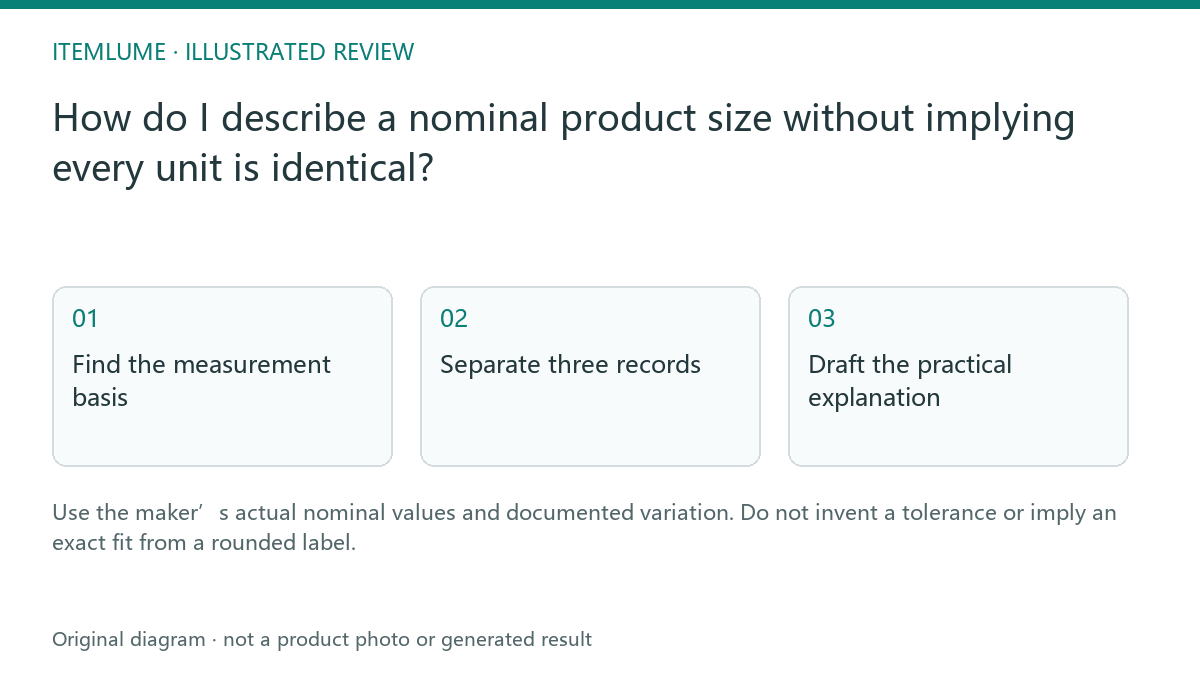
Find the measurement basis
A fictional handmade tray is described as approximately 30 cm wide. A generated specification paragraph changes that to exactly 300.00 mm and says it fits every 30 cm shelf. The rewrite adds precision and a fit promise. Obtain the maker’s measurement basis and any established variation before choosing the wording.
A unit conversion does not improve the underlying measurement certainty. If no tolerance record exists, keep that uncertainty explicit rather than asking the model for a plausible plus-or-minus number.
Separate three records
| Record | Source | Copy boundary |
|---|---|---|
| Nominal size | Maker specification | State the documented basis |
| Variation | Actual maker measurement/process record | Do not invent a tolerance |
| Buyer fit | Customer opening and required clearance | Do not infer from nominal size alone |
The table is an editorial worksheet, not a dimensional engineering standard. Products with critical fit requirements need appropriate qualified measurement and responsible review.
Draft the practical explanation
Explain how the buyer should interpret the stated size and where the verified detailed record can be found. Avoid wording that makes a handmade approximate dimension sound like a certified gauge. If a product requires clearance, use an established requirement instead of silently rounding it away.
For the tray example, a useful explanation distinguishes the nominal width from a guarantee of fitting a particular shelf. A generated scene on a shelf supplies visual context, not the customer’s actual measurements.
Review the specification image too
Compare the description, dimension graphic and product-selection text. A careful paragraph cannot repair a large “EXACT FIT” label in an image. Itemlume can illustrate measurements from supplied facts, but it does not measure the physical units or establish production tolerances. Keep the approved maker record linked to the published claim.
Sources and further reading
Sources for this page were checked on . Platform rules can change; verify the current source before publishing. Prompt examples and workflow recommendations are Itemlume editorial guidance, not independently measured results.
Frequently asked questions
Does converting units add certainty?
No. Preserve the underlying measurement basis.
Can AI supply a missing tolerance?
Use established maker information, not a guessed value.
Does a rendered shelf prove fit?
No. Use actual product and customer measurements.
BUILD FROM A PRODUCT YOU KNOW
Put this workflow into practice with your own product.
Explore the relevant tool first. AI copy and concept planning are free after sign-in. Image and video generation require available credits and the applicable account access.
Open A+ product pages Check pricing and credits