 Itemlume
DIAGNOSTIC GUIDE / A+ product pages
Why does the cheaper-looking pack cost more per gram?
Compare packs on the same measured basis, not on the largest price printed in the artwork. A lower package price can coexist with a higher price per gram. Verify the pack quantity and selling price before entering the unit-price fields in the store. Use transparent arithmetic and distinguish the larger purchase from the lower unit cost.
Pack price and unit price answer different questions
Pack price is what the order costs; unit price divides that price by a defined quantity and expresses it on a common base. Changing grams to kilograms changes the display scale, not the underlying value. Discounts, variants and incorrect total quantities can make an otherwise correct-looking calculation apply to the wrong offer.
A lower shelf price may belong to a smaller quantity. Before calling one pack better value, confirm what each price buys and whether the contents are genuinely comparable. A weight-based item should not be compared with a count-based offer without an explained, valid conversion.
Choose one shared quantity basis
Record the selected variant, sale price, net quantity and comparison base. Convert quantities into the same unit, calculate independently, then compare the result with the actual store fields and rendered page. Check another pack using the same base; avoid comparing one per-gram label with another per-kilogram label.
Write the confirmed amount, price and shared basis before calculating. Keep the arithmetic visible: price divided by quantity, multiplied by the chosen basis. If a bundle contains unlike components, one total may not support a meaningful same-product unit comparison.
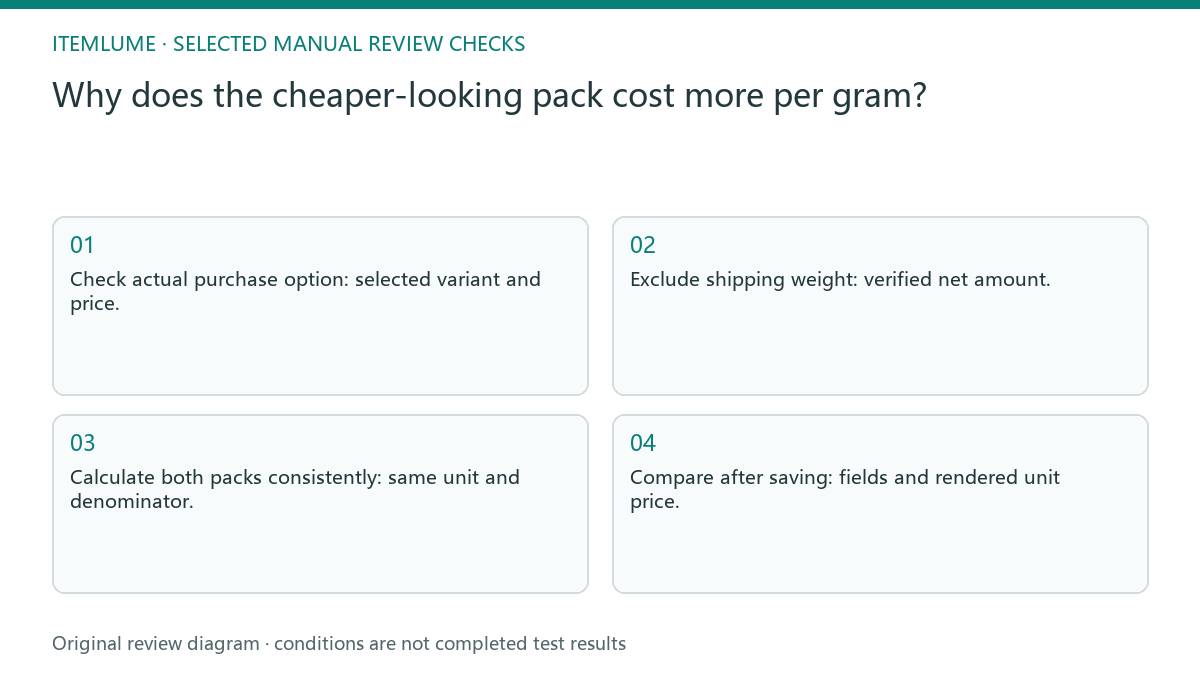
- Check actual purchase option: selected variant and price.
- Exclude shipping weight: verified net amount.
- Calculate both packs consistently: same unit and denominator.
- Compare after saving: fields and rendered unit price.
Compare fictional 100 g and 200 g packs
Fictional exercise: pack A costs 6 for 100 g; pack B costs 10 for 200 g. On a common 100 g basis, A is 6 and B is 5. B has the higher pack price but lower unit price. These are invented teaching figures, not a real shop offer or a legal pricing determination.
Now change only one fictional input: suppose the confirmed net quantity for B is corrected to 150 g while its price stays 10. Its price per 100 g becomes about 6.67, so the earlier ranking reverses. Correct the worksheet, any drafted comparison and the store fields; do not keep the old claim because its arithmetic used to be right. This counterexample shows why quantity provenance matters. Unlike contents or offer conditions still need separate explanation, and a unit-price result makes no quality claim.
Do not promise the cheapest option without complete facts
Stop if quantity refers to shipping weight, an unconfirmed usable amount or a different SKU. Correct the denominator before using the comparison in copy.
Recalculate when the pack quantity or offer conditions change. Where a jurisdiction or storefront specifies unit-price display, verify that current requirement separately. The store operator verifies unit-price fields and destination requirements. AI can draft explanatory copy from supplied facts; it cannot determine the real selling price or the business’s legal obligations.
Offer identity to store result: decision worksheet
| Check | Evidence to record | Review action |
|---|---|---|
| Offer identity | Selected variant and price | Check actual purchase option |
| Quantity | Verified net amount | Exclude shipping weight |
| Common base | Same unit and denominator | Calculate both packs consistently |
| Store result | Fields and rendered unit price | Compare after saving |
Use this matrix as a manual review record and add your own real evidence. Its conditions are not completed test results.
Sources and further reading
Sources for this page were checked on . Platform rules can change; verify the current source before publishing. Prompt examples and workflow recommendations are Itemlume editorial guidance, not independently measured results.
Frequently asked questions
Is a cheaper pack automatically better value?
No. Confirm comparable contents and compute both prices on the same quantity basis.
Can I compare grams directly with item count?
Not without a justified conversion. Keep incompatible bases separate.
Does this establish legal display requirements?
No. Check current rules for your sales jurisdiction and storefront.
BUILD FROM A PRODUCT YOU KNOW
Put this workflow into practice with your own product.
Explore the relevant tool first. AI copy and concept planning are free after sign-in. Image and video generation require available credits and the applicable account access.
Open A+ product pages Check pricing and credits