 Itemlume
DIAGNOSTIC GUIDE / Product images
Should a new-product photo show the protective film or the uncovered surface?
Show the state that helps buyers understand both what arrives and what the product looks like when used. First confirm whether the film is a removable shipping protection or a permanent layer. Use real approved samples of the covered and uncovered states where removal is permitted. Do not remove an unknown coating, or let AI erase a protective layer and present the imagined surface as evidence.
Confirm the layer’s purpose
Ask the product owner to identify the layer and the permitted handling instructions. A peel tab is a useful observation but not sufficient authority to remove an unknown surface. Record whether the delivered unit includes the layer and which areas are actually covered.
Keep shipping state separate from finished appearance. A dull film can obscure a polished face, while a clear layer may be part of the functional product. A generic cleanup instruction can delete the wrong thing if the brief simply says “remove imperfections.”
Use actual examples of each permitted state
Photograph an approved covered sample for the arrival view and an approved uncovered sample for the finish view. Keep product identity, lighting context and state labels understandable. A generated uncovered view cannot establish scratches, texture or color that the source never revealed.
Explain the states near the relevant pictures when needed. Do not make the film itself look like a permanent decoration, or imply every customer receives an already-uncovered surface. The owner must approve the wording and any handling instruction rather than letting the copy model invent a removal procedure.
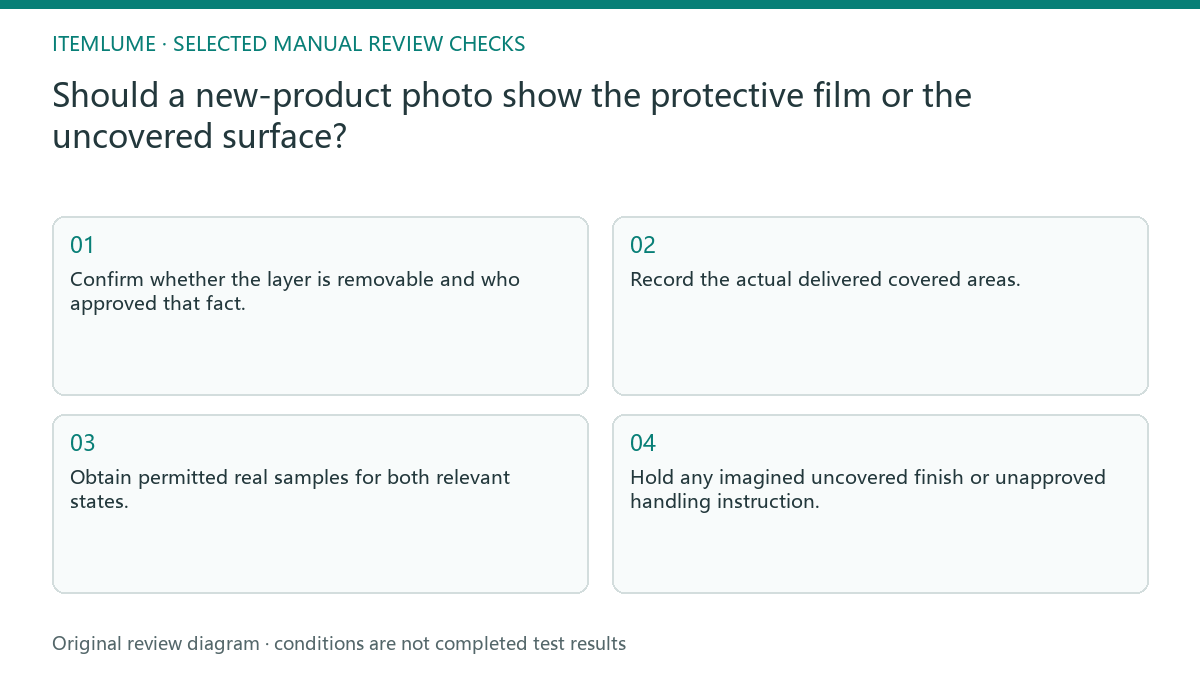
- Confirm whether the layer is removable and who approved that fact.
- Record the actual delivered covered areas.
- Obtain permitted real samples for both relevant states.
- Tie each photograph and statement to the correct state.
- Hold any imagined uncovered finish or unapproved handling instruction.
Fictional exercise: a glossy tray looks matte on arrival
This fictional exercise uses a tray shipped with a dull removable film. The concept shows only a glossy uncovered face, and an arrival reviewer thinks the shipped item is a different finish. The example is invented and does not describe a measured customer complaint.
The team obtains owner-approved photographs of both states and clarifies their roles. They do not ask AI to prove the hidden gloss from the covered image. If removability is still unconfirmed, they retain the covered-state evidence and pause the uncovered claim.
Approve arrival expectation and finish separately
Retain the layer identification, source samples and final state labels with the creative. If the supplier changes shipping protection, update the arrival information even when the product’s finished face remains the same. Review cleanup requests against this record before altering future images. Retain the state label when recropping for another channel. A close crop can remove the cue that explained the film, so compare the new image and caption rather than inheriting the full-image approval.
Stop when the advertised states match the real delivery and permitted appearance, with uncertain surface changes excluded. This is a product-representation check, not a safety instruction or automated Itemlume surface analysis. A new film or coating needs fresh confirmation rather than the previous template.
Covered versus uncovered states
| Observation | Manual check | Stop or approve |
|---|---|---|
| Layer purpose unknown | Ask product owner | Do not remove or erase |
| Shipping film confirmed | Record delivered areas | Arrival view approved |
| Uncovered finish | Use permitted actual sample | No imagined evidence |
| Shipping method changed | Review state labels | Renew arrival approval |
Use this matrix as a manual review record and add your own real evidence. Its conditions are not completed test results.
Sources and further reading
Sources for this page were checked on . Platform rules can change; verify the current source before publishing. Prompt examples and workflow recommendations are Itemlume editorial guidance, not independently measured results.
Frequently asked questions
Can I call every clear layer protective film?
No. Confirm its purpose and removability with the owner’s documentation.
Can AI reveal the hidden surface?
A plausible reconstruction does not prove its real finish; obtain a supported sample.
Must I use both states as main images?
Choose roles based on buyer needs and current destination rules; this guide supplies no universal placement rule.
BUILD FROM A PRODUCT YOU KNOW
Put this workflow into practice with your own product.
Explore the relevant tool first. AI copy and concept planning are free after sign-in. Image and video generation require available credits and the applicable account access.
Open Product images Check pricing and credits