 Itemlume
DIAGNOSTIC GUIDE / Virtual try-on
How do I show a reversible garment without implying buyers receive two pieces?
Show two ways to wear the same physical garment and make the single-item quantity explicit. Use a real reference of both supported faces and, where useful, the actual reversal. A paired composition can look like a two-piece bundle if each view appears to be a separate sale item. Keep styling choices distinct from the evidence that the garment is genuinely reversible.
Establish a single-item identity
Record the garment SKU, quantity and owner-confirmed reversibility. Identify face A and face B with stable names rather than treating them as two color SKUs. The labeling should explain the same item, not invent a discount bundle or duplicate inventory.
Photograph the actual two faces and relevant construction, including details whose role changes when reversed. Do not ask a model to fabricate the unseen interior. A visually plausible lining does not prove the garment can be worn that way or that both faces have equivalent functional properties.
Design the two-view relationship
Make the relationship visible through a shared identity label, clear face names or an approved explanatory caption. Keep images large enough to inspect the actual product, while avoiding two independent product cards with separate apparent offers. The buyer should understand “one garment, two supported views.”
Review nearby copy, quantities and variant selectors together with the image. A visual explanation cannot compensate for a checkout offering a different bundle. If a demonstration is used, keep the actual reversal understandable and do not replace missing construction evidence with a cinematic transformation.
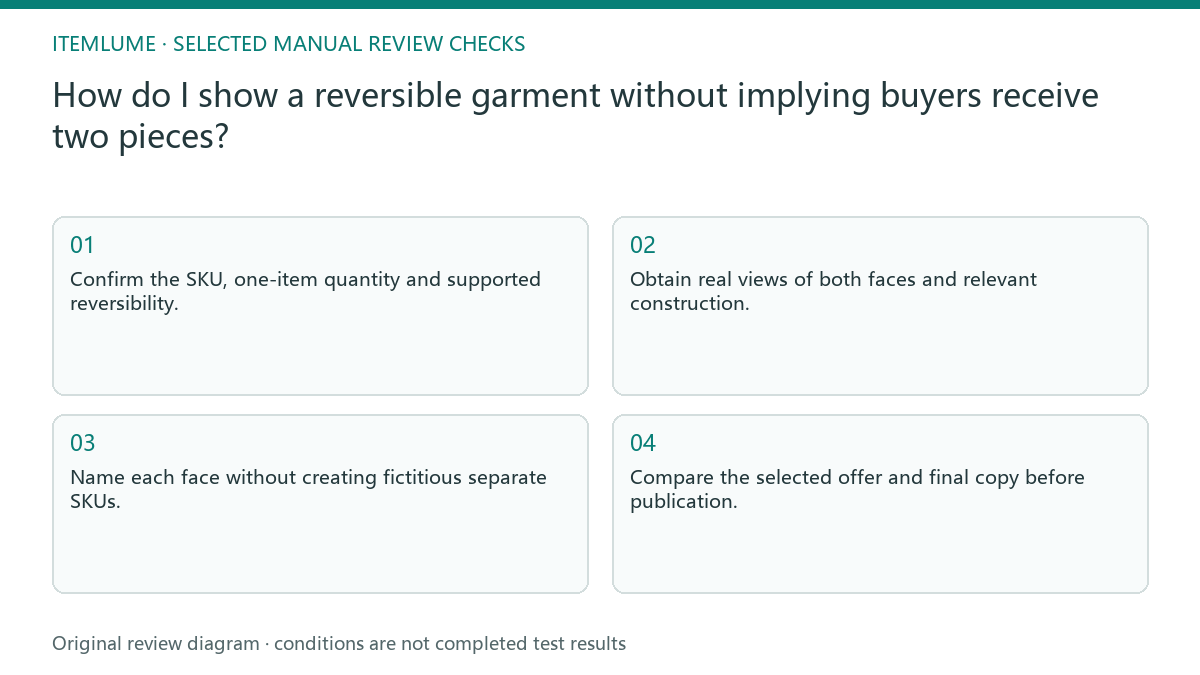
- Confirm the SKU, one-item quantity and supported reversibility.
- Obtain real views of both faces and relevant construction.
- Name each face without creating fictitious separate SKUs.
- Ask an unbriefed reviewer how many pieces they expect.
- Compare the selected offer and final copy before publication.
Fictional exercise: two jacket cards imply two pieces
This fictional exercise shows the two faces of one reversible jacket in separate cards. A reviewer expects a set of two jackets. The illustration is invented and does not report a customer survey, conversion result or an Itemlume try-on test.
The team replaces the independent cards with a single-item explanation and repeats the quantity question. If a reviewer still expects two pieces, the relationship is revised again. The stopping rule is a correct item-count interpretation backed by real face references, not merely a more attractive layout.
Approve quantity, appearance and fit claims separately
Keep the two face references, final labels and quantity review with the asset. Inspect which pockets, fastenings or marks are visible on each face against the real product. A supported appearance does not establish fit, warmth or any other performance claim. A shared decorative background does not prove the views are one item. Inspect the quantity signal after cropping, because a single face may lose the original relationship explanation in a reused asset.
Itemlume visual creation and try-on are creative workflows, not construction or fit validation. Stop when both views and the offer quantity are accurate, with unsupported assertions removed. If the supplier changes either face, update its reference before reusing the previous single-item presentation.
One garment, two faces
| Observation | Manual check | Stop or approve |
|---|---|---|
| Two apparent product cards | Ask expected quantity | One-item relationship clear |
| Unseen inner face | Obtain actual reference | Hold invented structure |
| Face names differ | Check shared SKU | No fictitious variants |
| Fit wording added | Seek separate evidence | Do not infer from image |
Use this matrix as a manual review record and add your own real evidence. Its conditions are not completed test results.
Sources and further reading
Sources for this page were checked on . Platform rules can change; verify the current source before publishing. Prompt examples and workflow recommendations are Itemlume editorial guidance, not independently measured results.
Frequently asked questions
Are two faces two variants?
Not automatically. Use the actual catalog identity and sale quantity.
Can AI invent the second face?
A plausible image is not evidence of its real construction; obtain the actual reference.
Does correct try-on prove reversible wear?
No. Verify the garment’s construction and approved wearing instructions independently.
BUILD FROM A PRODUCT YOU KNOW
Put this workflow into practice with your own product.
Explore the relevant tool first. AI copy and concept planning are free after sign-in. Image and video generation require available credits and the applicable account access.
Open Virtual try-on Check pricing and credits