 Itemlume
DIAGNOSTIC GUIDE / A+ product pages
How should copy distinguish cartons, inner packs and individual pieces?
Build a quantity tree before writing the headline: carton, inner pack and individual piece can each be the order unit. The buyer must know which level the shown price buys and how the lower levels relate. Do not treat a display containing every piece as the default quantity for each selectable SKU. Check how the order unit maps to received pieces before displaying a wholesale price.
Order unit and total pieces are not interchangeable
Packaging hierarchy and price denominator are related but not identical. A carton may contain several retail packs, each containing multiple items. The supplier’s pack configuration can change by SKU, so multiplying one remembered example across the catalog can create incorrect quantities even when the product photograph is accurate.
Identify the priced tier before multiplying: one carton, one retail box or one individual piece. The image may show a display containing every item, while the selected option buys only one tier. Separate net weight from gross shipping weight so quantity explanations do not mix contents with packing.
Draw the carton-to-box-to-piece tree
Obtain the actual order unit and each parent-to-child count from the supplier’s approved pack record. Draw the hierarchy, multiply to check totals and label which level is priced. Compare the purchase option, title, image and dispatch description against that tree, retaining a separate row for any SKU with a different configuration.
Record each parent-to-child count from the approved packing record and label any SKU that differs. Calculate the total, then verify title, image, price and dispatch description against the tree. A valid multiplication cannot repair an unverified starting count.
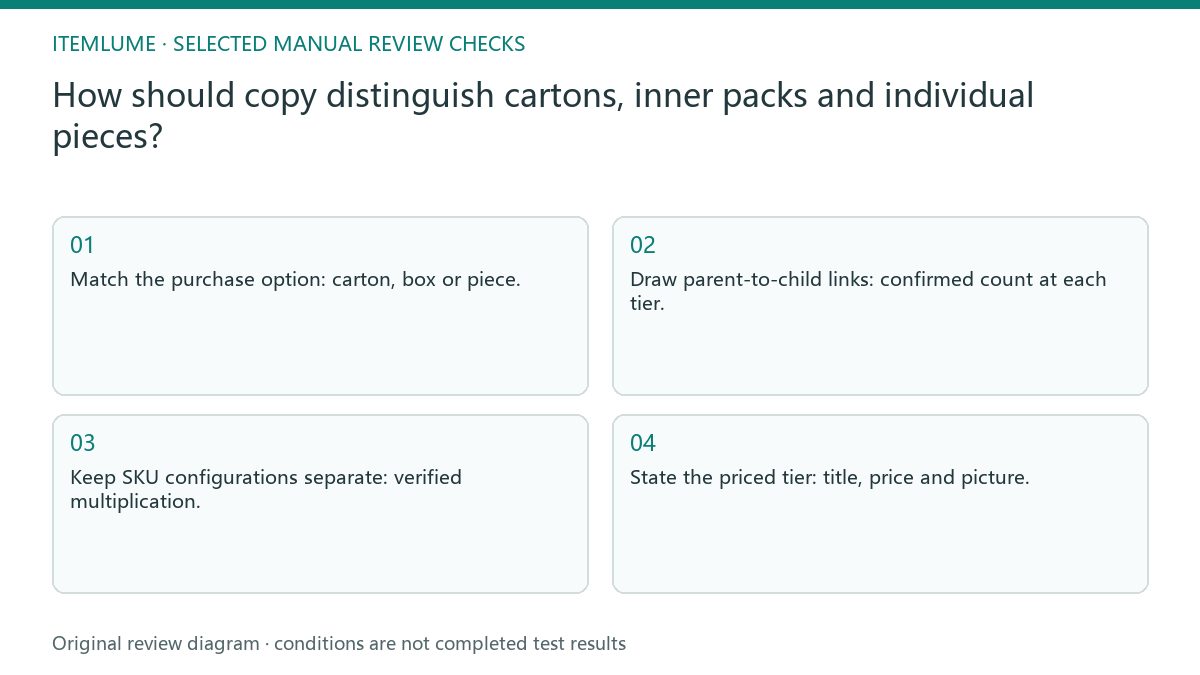
- Match the purchase option: carton, box or piece.
- Draw parent-to-child links: confirmed count at each tier.
- Keep SKU configurations separate: verified multiplication.
- State the priced tier: title, price and picture.
A carton of 12 boxes with two clips each
Fictional exercise: one carton contains 12 retail boxes, each with two clips, for 24 clips in total. A selectable single-box option still buys only two clips. The creative labels both routes and their quantities. Invented teaching counts do not establish the seller’s genuine pack configuration or wholesale quote.
The fictional carton contains 12 boxes with two clips in each: 24 clips total. A single-box option contains two, not 24. Ask a reviewer to name the received quantity for both options without seeing the supplier sheet; ambiguity points to the creative, not the arithmetic. If two SKUs share an outer carton but differ in inner counts, draw separate trees and prices. A carton photograph cannot identify hidden packing. For weight-based offers, name net or gross explicitly before comparing quantities or describing what the buyer receives.
Keep SKU configurations separate
Stop if a tier count, order unit or SKU configuration is unknown. Do not have AI infer hidden inner packs from the outer carton picture.
Unknown tier counts or weight definitions require supplier clarification. Do not infer unseen inner packs from a carton photo or synchronize the catalog from one remembered example. The supplier and seller verify packing quantities. Itemlume can draft a visual explanation from confirmed counts but does not inspect cartons or synchronize wholesale inventory.
Order unit to creative promise: decision worksheet
| Check | Evidence to record | Review action |
|---|---|---|
| Order unit | Carton, box or piece | Match the purchase option |
| Hierarchy | Confirmed count at each tier | Draw parent-to-child links |
| Total check | Verified multiplication | Keep SKU configurations separate |
| Creative promise | Title, price and picture | State the priced tier |
Use this matrix as a manual review record and add your own real evidence. Its conditions are not completed test results.
Sources and further reading
Sources for this page were checked on . Platform rules can change; verify the current source before publishing. Prompt examples and workflow recommendations are Itemlume editorial guidance, not independently measured results.
Frequently asked questions
Does a single-box option buy the carton total?
No. Match the price to its selected tier and show the lower-level quantity it actually contains.
Can I infer inner packs from the outer image?
No. Obtain the approved packing record and keep unknown counts unresolved.
May I label gross shipping weight as net contents?
No. Confirm the actual weight definition and keep packaging weight separate.
BUILD FROM A PRODUCT YOU KNOW
Put this workflow into practice with your own product.
Explore the relevant tool first. AI copy and concept planning are free after sign-in. Image and video generation require available credits and the applicable account access.
Open A+ product pages Check pricing and credits