 Itemlume
DIAGNOSTIC GUIDE / Logo studio
How do I brief two approved brand names that are not literal translations?
Treat the approved Chinese and English names as two exact identity fields, not a translation request. Tell the designer how they belong to the same brand, which version leads in each use, and which alternate spellings are prohibited. An attractive bilingual logo cannot establish naming rights, pronunciation or business history that the owner has not confirmed.
Create an approved-name correspondence card
Record each exact written name, its role and any owner-approved pronunciation guidance. If the names are not literal translations, say so explicitly. A shared brand identity does not require the model to invent an etymology explaining how every character maps to an English syllable.
List rejected variants or convenient abbreviations that must not appear in artwork. Preserve punctuation, spacing and capitalization where approved. Ask the owner to settle genuine ambiguity before visual exploration; do not resolve it with whichever generated spelling looks most balanced.
Define visual hierarchy by application
Specify the real applications, such as a local shop sign or a wider international header. Decide which approved name leads and how the secondary name supports it. A change in hierarchy should not silently remove an essential identity field or create a third combined brand name.
Review both language versions with readers who can identify the names. Compare the visual file with the text record character by character. Itemlume’s raster concept can explore the arrangement, but exact production typography and vector assembly are separate external design work.
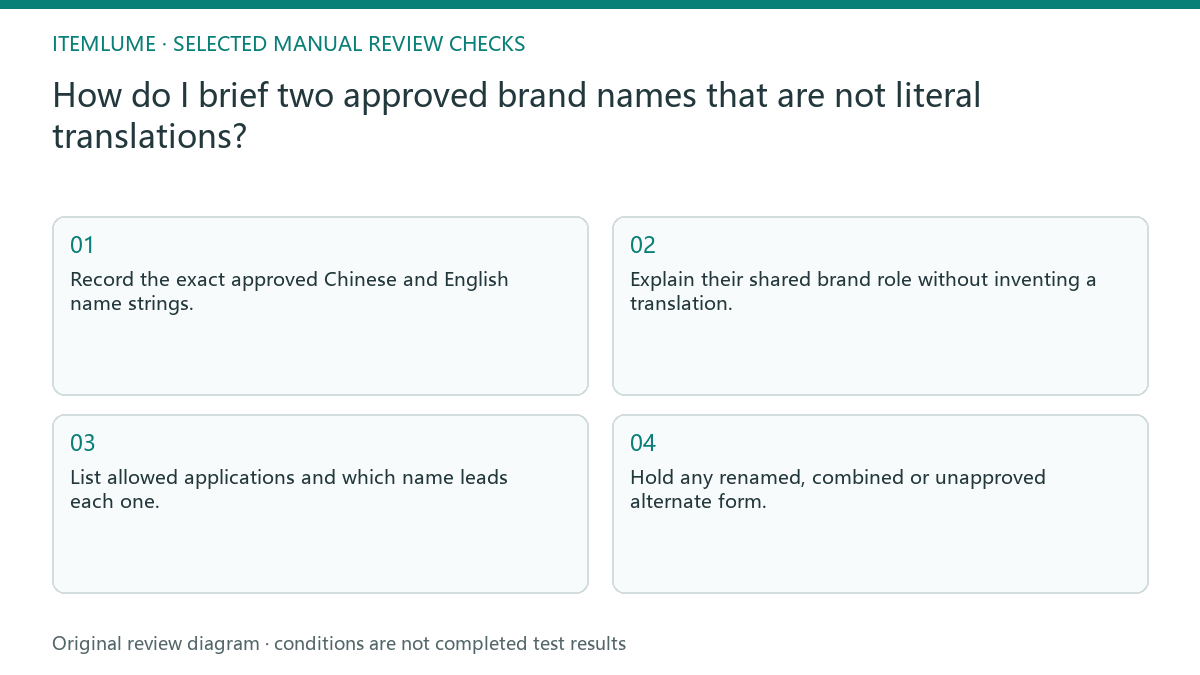
- Record the exact approved Chinese and English name strings.
- Explain their shared brand role without inventing a translation.
- List allowed applications and which name leads each one.
- Compare every character and spacing with the written record.
- Hold any renamed, combined or unapproved alternate form.
Fictional exercise: two names are incorrectly translated
This fictional exercise uses the invented names “山岚” and “Mora Studio” for one fictional brand. A draft replaces the English name with a literal translation of the Chinese. The scenario does not assert any real trademark, pronunciation or company relationship.
The reviewer restores the two approved strings and states their intended hierarchy. They do not justify the replacement by claiming literal translation is more international. The stop condition is exact identity correspondence and readable application, not a newly invented story connecting the names.
Keep identity approval separate from legal clearance
Save the correspondence card and approved applications with the visual file. A later rename or market-specific arrangement requires a deliberate update. Reusing the image does not automatically reuse an owner’s approval for a different name or context. A pronunciation aid belongs in the briefing record unless the owner explicitly wants it displayed. Adding it to the mark can create an unapproved third string that must not be mistaken for the brand name.
Stop when both displayed names match the owner-approved record and their relationship is clear to the intended readers. This guide does not verify trademark availability, font permission or naming rights. Raster generation, exact typography and legal clearance are distinct tasks with different evidence.
Bilingual name correspondence
| Observation | Manual check | Stop or approve |
|---|---|---|
| Chinese name | Compare exact string | Approved spelling preserved |
| English name | Confirm not a translation task | No invented replacement |
| Hierarchy differs | Check application purpose | Owner approves arrangement |
| Third combined name | Compare identity record | Hold renaming |
Use this matrix as a manual review record and add your own real evidence. Its conditions are not completed test results.
Sources and further reading
Sources for this page were checked on . Platform rules can change; verify the current source before publishing. Prompt examples and workflow recommendations are Itemlume editorial guidance, not independently measured results.
Frequently asked questions
Must two names mean the same thing?
Use the owner’s actual identity decision; do not invent a literal relationship.
Can AI invent a pronunciation story?
No. Keep pronunciation and history limited to confirmed owner information.
Does an approved image clear the name?
No. Visual approval is different from naming rights, font permission or trademark review.
BUILD FROM A PRODUCT YOU KNOW
Put this workflow into practice with your own product.
Explore the relevant tool first. AI copy and concept planning are free after sign-in. Image and video generation require available credits and the applicable account access.
Open Logo studio Check pricing and credits