 Itemlume
Assets & tasks / PRACTICAL ANSWER
Should every product filter combination become a separate search landing page?
Create a durable landing page for a useful distinct buyer need. Do not treat every color, sort and availability combination as a new article.
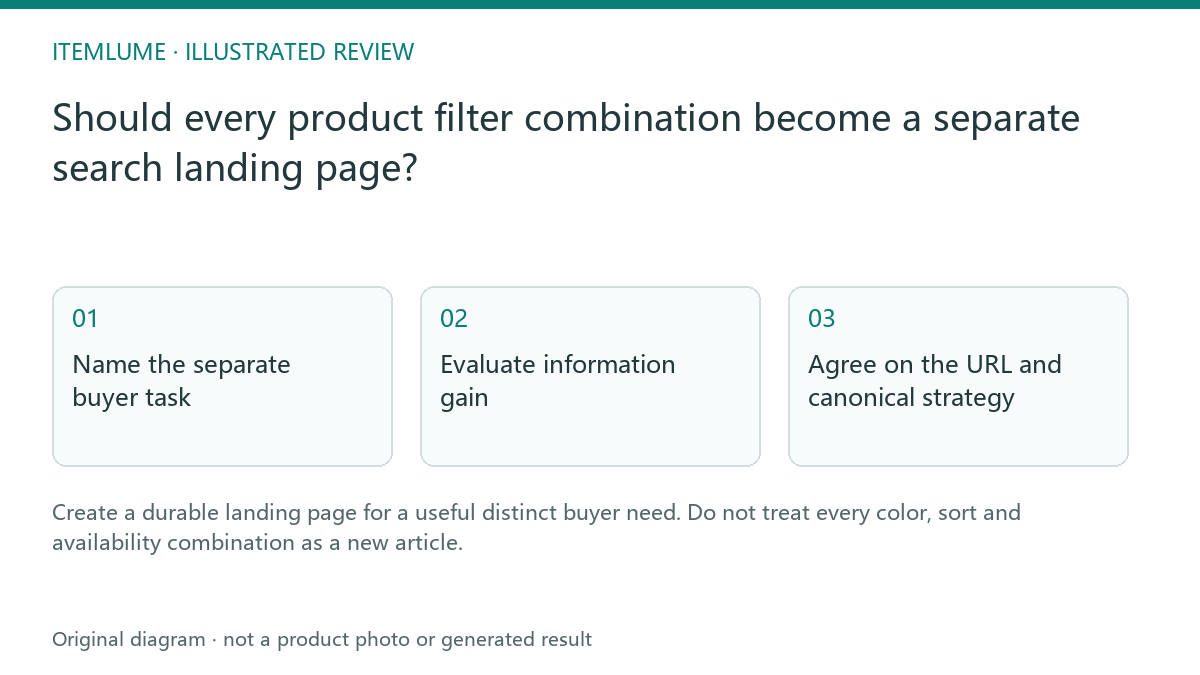
Name the separate buyer task
A fictional bag store has filters for capacity, material, color and sort order. “Water-resistant commuting bags” may answer a genuine selection task with useful explanations. “Blue + newest first + in stock today” may merely describe a temporary interface state. Write what a shopper learns on the proposed landing page beyond the same product grid.
The decision is editorial before it is technical. Product eligibility and factual claims still need evidence. Do not turn a filter label into a waterproof claim when the catalog supports only a limited water-resistance statement.
Evaluate information gain
| Candidate | Additional buyer value | Decision |
|---|---|---|
| Commuting bags | Capacity/use tradeoffs and verified product selection | Consider a maintained landing page |
| Blue sorted newest | Same items in another order | Usually retain a filter state |
| Today’s stock subset | Rapidly changing availability | Avoid a misleading evergreen promise |
These are illustrative choices, not a universal rule for all catalogs. If a category deserves a page, give it a stable linked destination, specific copy and an accountable maintenance owner.
Agree on the URL and canonical strategy
Give the developer the chosen editorial pages and the remaining interface states. Ask them to review crawlability, canonicalization and filter URL behavior against the current site architecture. A canonical hint should reflect the actual relationship between pages, not be applied mechanically to unrelated useful content.
Do not point every useful filtered landing page at the root category while expecting its distinct explanation to be independently discoverable. Conversely, dozens of nearly identical pages can create confusing duplication.
Review usefulness over time
Check whether the curated products still satisfy the stated need and whether the explanatory copy is current. Use actual search and customer data when available; do not claim a keyword opportunity from the existence of a filter. Itemlume can help draft the creative and factual explanation, but filter routing and indexing controls are store implementation work.
Sources and further reading
Sources for this page were checked on . Platform rules can change; verify the current source before publishing. Prompt examples and workflow recommendations are Itemlume editorial guidance, not independently measured results.
Frequently asked questions
Should sort order create a new guide?
Usually it changes presentation without adding a distinct answer.
Can a useful filtered collection be public?
Yes, with its own maintained buyer value and deliberate URL strategy.
Does canonicalization replace content review?
No. Decide the real page relationship first.
BUILD FROM A PRODUCT YOU KNOW
Put this workflow into practice with your own product.
Explore the relevant tool first. AI copy and concept planning are free after sign-in. Image and video generation require available credits and the applicable account access.
Open Assets & tasks Check pricing and credits